To keep a food diary for weight loss, write down everything you eat and drink, with an amount, at the time you eat it, on weekends as well as weekdays. The entries that matter most are the ones people skip: cooking oil, dressing, creamer and drinks. According to USDA FoodData Central, a tablespoon of olive oil is about 119 kcal and a 12 fl oz can of cola about 156 kcal. In a systematic review of weight-loss studies, keeping a food record was consistently associated with losing weight (Burke et al., 2011). That is an association, not a promise, and the authors rated the evidence as weak.
This article is general information about keeping a food diary. It is not medical advice. If you have a health condition, are pregnant, or have a history of disordered eating, talk to a doctor or a registered dietitian before you start tracking food.
What to write down every time you eat
Every entry needs two things: what the food was and how much you had. Without an amount, you can’t turn an entry into calories, so that column matters more than the rest.
| Write down | Example | Why it matters |
|---|---|---|
| The food, specifically | “2 scrambled eggs”, not “eggs” | Different foods and versions have very different numbers |
| The amount | 1 cup, 6 oz, 2 slices, a 12 fl oz can | Calories scale with the amount |
| How it was cooked | Fried in 1 tbsp of butter | That tablespoon of butter adds about 102 kcal |
| Drinks | Coffee with 2 tbsp of half-and-half | Liquids count, and they’re the easiest thing to forget |
| Oils, sauces and condiments | 1 tbsp of mayonnaise on a sandwich | About 94 kcal per tablespoon |
| The time | 7:40 am | Shows patterns, like a long gap followed by a big evening snack |
Use units you can repeat. US cups and spoons are fine, and a kitchen scale is better for the foods you eat most often. For a dish you cooked yourself, work out the calories per portion once with the method in how to count calories in homemade food, then reuse that number.
NIDDK also suggests noting where you ate and why, alongside what, when and how much (NIDDK). I’d treat those two as optional. Start with the food, the amount and the time, and add more once the habit has stuck.
The calories a food diary usually misses
The entries that go missing tend to be small, fatty or liquid. Each one looks too minor to bother with, and together they are a meal’s worth. Here’s an example day written up in the evening from memory, with the items that never made it in. The day is made up; the calories are USDA’s.
| Meal | What got logged | What got left out | kcal left out |
|---|---|---|---|
| Breakfast | Oatmeal | 2 tbsp half-and-half (40) and 2 tsp sugar (32) in the coffee | 72 |
| Lunch | Turkey sandwich | 1 tbsp mayonnaise | 94 |
| Afternoon | Nothing | 1 oz of potato chips, about 22 chips (28 g) | 149 |
| Dinner | Grilled chicken salad | 1 tbsp olive oil in the pan (119) and 2 tbsp ranch dressing (129) | 248 |
| Evening | Nothing | A 5 fl oz glass of red wine (147 g) | 125 |
| Total | 688 |
That’s close to 700 kcal that never reached the diary, about a third of a 2,000 kcal day. None of it is unusual food. It’s the coffee, the condiments and the cooking fat.
Drinks deserve their own line in the diary. A 12 fl oz can of regular cola is about 156 kcal, a cup of orange juice about 112 kcal, and a 12 fl oz can of regular beer about 153 kcal.
If your diary says you’re under your target and your weight isn’t moving, these are the first entries I’d check. There are other reasons too, which I cover in not losing weight on a calorie deficit. For cooking fats in more detail, see calories in a tablespoon of butter and oil.
Four habits that make a food diary wrong
Most food diaries undercount. When researchers compare what people record with the energy they really use, measured with doubly labeled water, most studies find under-reporting and few find the reverse. One review pooled 59 such studies covering 6,298 adults (Burrows et al., 2019). In an older study of ten people who said they couldn’t lose weight on under 1,200 kcal a day, they had under-reported their intake by 47% on average (Lichtman et al., 1992). That’s a small group, but it shows how wide the gap can get. These four habits are behind most of it.
1. Writing it down later
A diary filled in at bedtime keeps the meals and loses the extras: the creamer, the handful of nuts, the bites from someone else’s plate. Log before you eat or straight after. If you can’t, snap a photo or type a quick note on your phone and turn it into an entry later.
2. Skipping weekends
Weekends are where a diary tells you the most. In a year-long trial of 48 adults aged 50 to 60, people ate more on Saturdays, and those on a calorie-restriction program kept losing weight on weekdays but stopped on weekends (Racette et al., 2008). A Monday-to-Friday diary would miss exactly that.
3. Guessing portions
A portion is the amount you actually eat. A serving is the amount printed on the Nutrition Facts label (NIDDK). They aren’t the same thing, so “1 serving of cereal” in a diary often means “whatever I poured”. For the first week or two, measure the foods you eat most: pour your usual bowl, then tip it into a measuring cup. After that you know what your bowl holds and can log it without measuring every time.
4. Logging the meal you meant to eat
“Salad” in the diary and a salad with croutons, cheese and dressing on the plate are different numbers. Write down what was on the plate, including the second helping. If a day went off plan, log it anyway. A rough entry tells you something; a blank day tells you nothing.
Paper notebook or app
Both work, and the research doesn’t pick a winner. In a 6-month weight-loss trial of 96 adults, people logged their food about as often in a paper journal as in an app or on a website, and BMI at 6 months didn’t differ between the three groups. App users did report eating fewer calories (Turner-McGrievy et al., 2013). Choose the format you’ll still be using in a month.
| Paper notebook | App | |
|---|---|---|
| To get started | A notebook and a pen | Install it and set a daily target |
| Calories and totals | You look them up and add them | Added up for you |
| Meals you repeat | Rewrite them each time | Save once, log again |
| Home-cooked and mixed dishes | Work out once, note the number | Photo or description gives an estimate to check, or type your own number |
| Showing a dietitian | Hand over the notebook | Show the screen or export the data |
| Trends over several weeks | Hard to see | Charts and weekly totals |
Paper suits people who don’t want their phone involved, or who mostly want to notice patterns rather than count. If you keep a paper food journal for weight loss, add a reference page at the back with the calories of the 20 or so foods you eat most, so you aren’t looking them up every day.
Keeping it going past the first month
Logging gets quicker with practice. In an online weight-loss program, people spent about 23 minutes a day on their food diary in the first month and about 15 minutes in the sixth. Those who lost at least 5% of their weight didn’t spend more time on it. They opened their diary more often each day, about 2.4 times versus 1.6 (Harvey et al., 2019). That’s another association, but the practical lesson is clear enough: small, frequent entries beat one long session at night.
What makes that easier:
- Log before you eat. It’s the moment you know exactly what’s on the plate and how much.
- Save the meals you repeat. Most people rotate through a handful of breakfasts and lunches. Save each one once, with every extra included, and logging it again is one tap.
- Write your usual order out in full once. Your regular coffee, your regular sandwich. Then you don’t have to rethink the creamer and the mayo each time.
- Log a rough entry rather than nothing. “Large burger and fries at a friend’s place” can be estimated. A gap can’t.
- Look back once a week. Note which meals took the most calories and which days went over. The weekly pattern is more useful than any single day’s total.
I built CaloriePix because the entry you make is worth more than the perfect one you skip. You can take a photo, type the meal in your own words, or say it out loud. Amounts help: “2 scrambled eggs and a slice of toast with butter” gets a better estimate than “breakfast”.
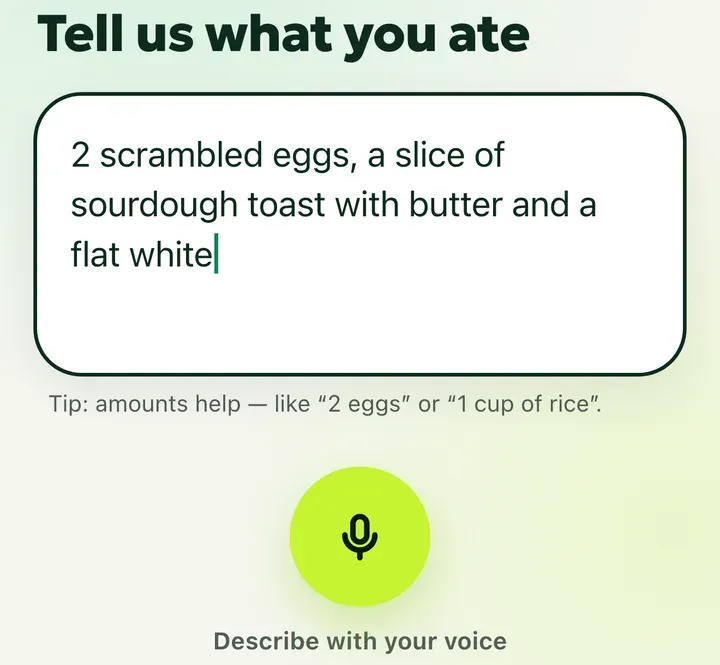
Each estimate comes up for review before it’s added. Change the portion and the numbers scale with it, or edit the quantity or nutrients of each ingredient. A photo can’t see the oil in the pan or the dressing tossed through a salad, so add those yourself before you save. For meals you repeat, use Save to my foods. If you’ve worked out a number yourself, Enter manually logs it as it is. And if you want to look at your weeks in a spreadsheet or take them to a dietitian, the app can export your meals, exercise and weight as a CSV file.
The short version: write it down before you eat, with an amount, and count the oil, the dressing and the drinks. Keep going on weekends. Then compare your daily total with a target from the calorie calculator, and judge progress by the weekly trend, not a single day.
This article is general information and is not medical advice.