To count calories in homemade food, add up the calories of the raw ingredients, weigh the finished dish, and then weigh the portion you eat. Your share of the calories is your portion’s share of the total weight. That one extra step, weighing the cooked dish, is what makes homemade food countable, because cooking changes the weight but not the calories.
This article is general information about logging food. It is not medical advice. If you have a health condition, are pregnant, or are making a big change to your diet, talk to a doctor or a registered dietitian.
The weigh-the-pot method
This is the most reliable way to count a dish you cooked yourself. You need a kitchen scale and about five minutes.
- Write down every ingredient with its raw weight, including the oil, butter, cream or sugar. Weigh what goes into the pot, not what you meant to use.
- Look up calories per 100 g for each ingredient, from the pack’s nutrition label or from USDA FoodData Central, the US government’s food composition database. Use the entry that matches the state you weighed: raw chicken, dry rice, and so on.
- Add up the total calories for the whole recipe.
- Weigh the finished dish. Weigh the empty pot before you start, then subtract it at the end, or move the food into a weighed container.
- Work out the calories per 100 g of the cooked dish: total calories ÷ cooked weight × 100.
- Weigh your portion and multiply.
Here is a worked example: a simple chicken curry, with values per 100 g from USDA FoodData Central.
| Ingredient (raw) | Weight | kcal per 100 g | kcal |
|---|---|---|---|
| Chicken breast, raw | 600 g | 120 | 720 |
| Onion, raw | 300 g | 40 | 120 |
| Canola oil (about 2 tablespoons) | 30 g | 884 | 265 |
| Plain whole-milk yogurt | 200 g | 61 | 122 |
| Total | 1,227 |
Garlic, ginger and ground spices add only a little in the amounts most curries use. Include them if you use a lot.
Now say the finished curry weighs 1,150 g once it has simmered down. That gives 1,227 ÷ 1,150 × 100 ≈ 107 kcal per 100 g. A 300 g bowl is about 320 kcal. If someone else takes a bigger bowl, it doesn’t change your number, because you weighed your own portion.
Why raw and cooked weights don’t match
Cooking drives water out of meat, vegetables and sauces, and grains soak water up. The calories stay put, so the calories per 100 g change. The USDA measures this as a “cooking yield”: the cooked weight divided by the raw weight.
You can see it in USDA’s own data:
- Chicken breast: 120 kcal per 100 g raw, but 165 kcal per 100 g roasted. Same chicken, about 37% more calories per 100 g once water has cooked off.
- White rice: 365 kcal per 100 g dry, but 130 kcal per 100 g cooked, because the rice has absorbed water.
The rule is simple: log food in the same state as the entry you choose. If you weigh cooked rice, use a cooked-rice entry. If you weighed the raw chicken before it went into the pan, use the raw entry for the whole recipe and let the weigh-the-pot method handle the rest. Mixing the two is the most common reason homemade logs are off.
Count every bit of oil, butter and ghee
Fats are where homemade calories hide. Olive oil has 884 kcal per 100 g, which works out to about 119 kcal per tablespoon. Two tablespoons add about 240 kcal to the pot.
In curries, stews, soups and sauces, the oil stays in the dish, so count all of it. When you shallow-fry and some oil is left in the pan, counting all of it slightly overestimates. I’d still count it: research that compares people’s food records with lab measurements has repeatedly found that we under-report what we eat, not over-report it (Burrows et al., 2019).
Without a scale: estimate with household measures
If you don’t have a scale, you can still get a reasonable number. It will be rougher, so be consistent rather than precise.
- Measure the ingredients with cups and spoons as you cook. USDA FoodData Central lists common household measures for most foods, so you can turn “1 cup” or “2 tablespoons” into grams.
- Split the pot into equal portions with the same ladle or bowl each time, and divide the total calories by the number of portions.
- Round up when you’re unsure, especially for oil and cream.
Using the same bowl every time does more for consistency than guessing a new weight at every meal.
Logging it in CaloriePix
When I built CaloriePix, I wanted homemade food to be quick to log, so there are a few ways to do it.
For a dish you’ve worked out with the weigh-the-pot method, log your portion with Enter manually. That way the number you calculated is the number in your diary.
For a plate you haven’t weighed, take a photo, or describe it in your own words. Amounts help: “a bowl of homemade chicken curry, about 300 g, made with 2 tablespoons of oil” gives a better estimate than “curry”.
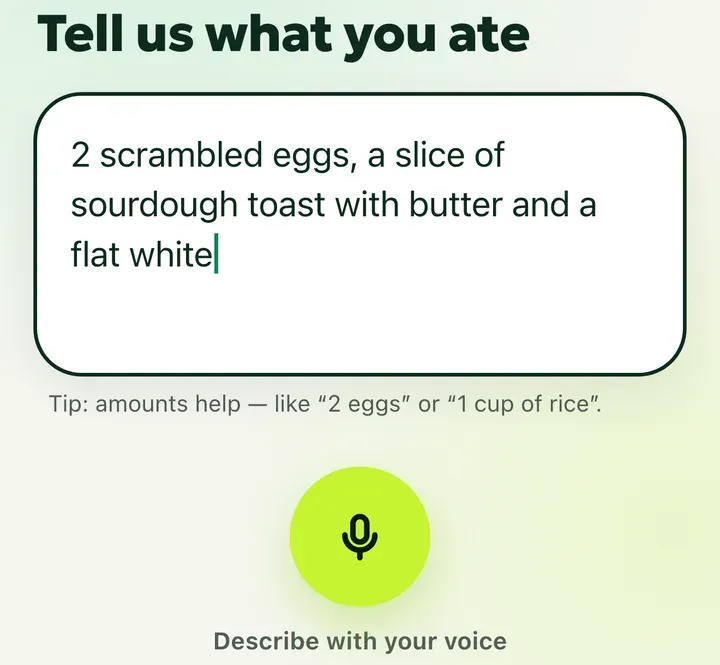
Either way, CaloriePix shows an estimate of the calories, protein, carbs and fat, and nothing is saved until you’ve reviewed it. You can change the portion, and everything scales together. You can also edit the quantity or nutrition of each ingredient, so if you know you used more oil than it assumed, change it.
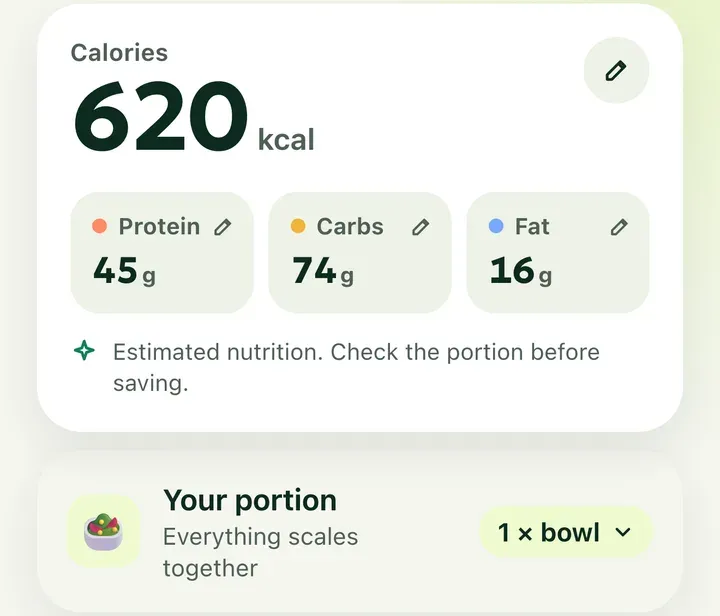
A photo estimate is still an estimate. It can’t see oil that was stirred into a sauce or tell you how full your bowl really is, so check those before you save. I explain where photo estimates go wrong, and how to get better ones, in how accurate AI calorie counting is.
If you cook the same dish often, use Save to my foods on the review screen. Next time you can log it again in one tap instead of starting over.
Which method to use when
| Situation | Best method |
|---|---|
| A dish you cook every week | Weigh the pot once, then reuse the number |
| A one-off recipe at home | Weigh the pot, or photo it and check the portion and oil |
| Someone else cooked it | Photo or description, then add the oil or sauce you can see |
| No scale in the house | Household measures, same bowl every time, round up |
The calories you log are only half the picture. The other half is your daily target, and the calorie calculator shows how many calories you need to maintain, lose or gain weight. The macro calculator splits that into protein, carbs and fat.
This article is general information and is not medical advice.